r é n In the Kitchen With: Edgard Sanuy Barahona
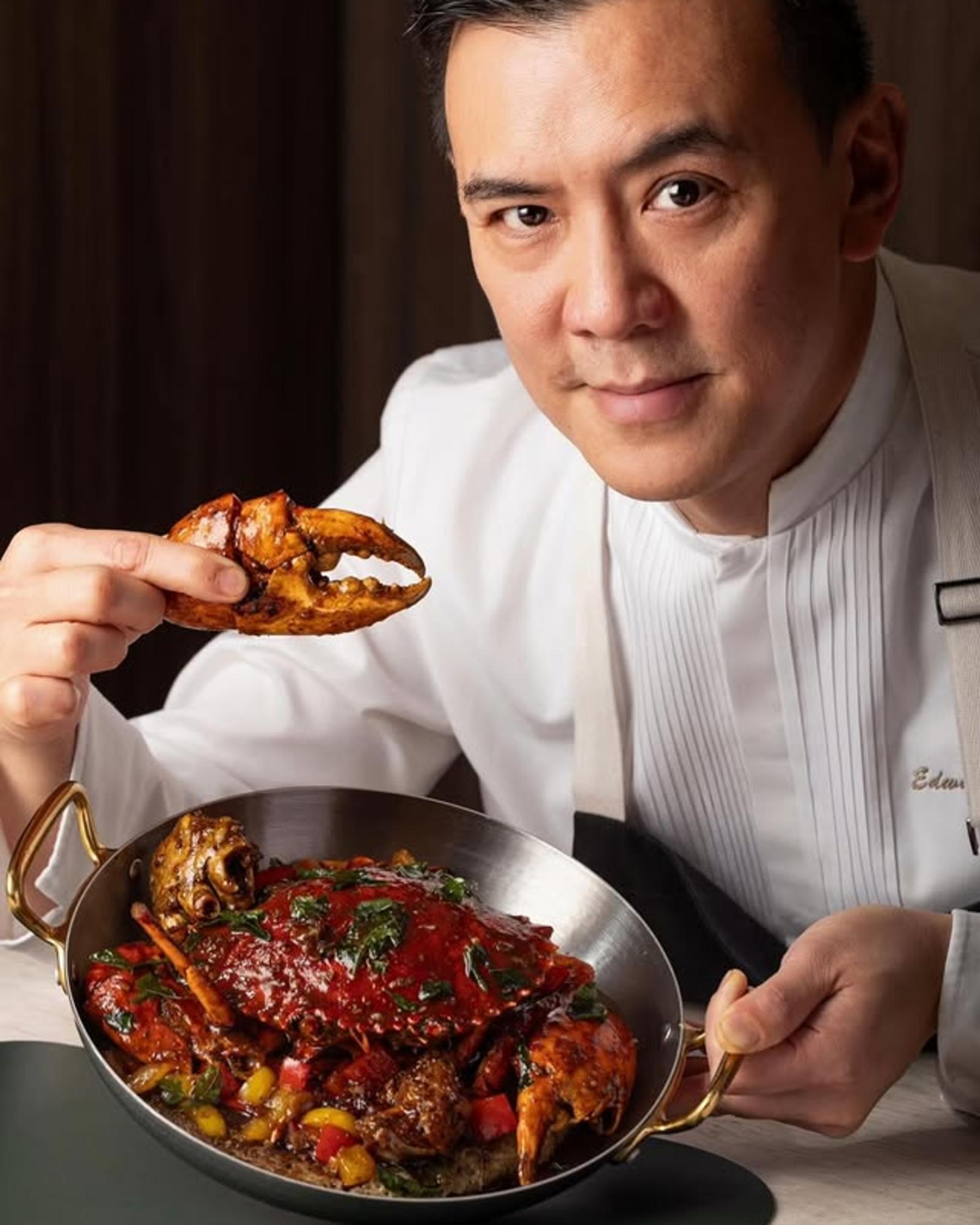
Having helped open and run some of the most exciting restaurants in our city, chef Edgard Sanuy Barahona is now moving onto something he can finally truly call his own: Lola Maria.

Since arriving in Hong Kong more than a decade ago, Edgard Sanuy Barahona has steadily built up his reputation as a visionary – someone you’d have on speed dial if you were in the business of opening restaurants. From Mott 32 and Limewood to a whole host of Spanish powerhouses like Pica Pica, Bàrbar, Pintxos by Bàrbar, and Aire, the Spanish chef has established and run some of our favourite restaurants during his stints with Maximal Concepts and subsequently Epicurean. But though you might think he’s done it all, according to him, there’s still something he’s yet to achieve.
“I think in Hong Kong, we still don’t have a benchmark for a neighbourhood Spanish restaurant, something street-level for everyone,” he tells us. “There are benchmarks for pasta, for Thai food, and even dumplings – but with Spanish restaurants, even though we have many that are great, there is still this gap in the market.”
He gives the names of 22 Ships, La Paloma, La Rambla, Bayfare Social and Bàrbar – all restaurants he loves – as examples. “When you ask your friends out for Spanish food, if you want to go to the best ones, those will be the choices,” he says. “But if you want to go for a value-for-money no-brainer, come to Lola Maria.”

Combining Maria – the most common name in his home country – as a representation of its connection to the masses with the shorthand of Dolores – one often used by actresses, singers, and artists – to convey creativity and uniqueness, the new Spanish joint calls 108 Hollywood Road its home. Affordability plays a key role in Lola Maria’s menu, though you can rest assured Edgard – the restaurant’s founder and director – is not one to ever sacrifice quality. “The price point has to be very important; street-level tapas have to be affordable, and I want my restaurant to be somewhere people can go every week, not just a place for special occasions.
“In terms of planning the menu, it means that a lot of the work I’m doing now is thinking about how I can do different dishes in a more affordable way. Diners in Hong Kong are very savvy, and they have certain expectations, so we need to be able to meet that standard whilst at the same time keeping the price point friendly. I want Lola Maria to be everyman’s Spanish restaurant, and so these are some of the challenges we need to face.”
For anyone familiar with Edgard’s roots, the desire to create something truly for the casual, everyday diner wouldn’t come as a surprise. Like many of his Mediterranean compatriots, food and family came hand in hand. His grandmother, in fact, was a chef herself.
“My grandmother worked in one of the most famous restaurants in the city where I was born, so food had always been a big part of my life,” the chef recounts. “Growing up in Spain, we ate at home a lot, and pasta was an easy thing to cook for families and kids, so it was my favourite food. My grandma was the only one that would ask me what I wanted to eat – because your mother would just cook whatever she wanted you to eat – and I’d always say pasta, any type!”

His grandmother may have played a big part in his culinary journey, but it was actually all the eating at home that inspired him to start cooking for himself. His family was middle class, he says, but his mother was also very conscious about spending money, and so dining out at restaurants was reserved only for special occasions and celebrations.
“I think the fact of wanting to eat good food and not being able to do so at restaurants is why I started cooking,” Edgard says with a chuckle. “Now in Hong Kong, if I want lobster rice, I’ll just pay for lobster rice. But when I was 17, I didn’t have the money, and I always wanted to eat nice things, so I asked my grandmother how to cook it. She knew how to make all these dishes, so I’d call her and ask her to teach me, and that’s how I started learning how to cook.”
Naturally, his love for cooking grew, until eventually he enrolled into culinary school to further hone his craft. Before long, he found himself in the kitchen of a Michelin-starred restaurant, filling in a vacancy for another former student from his school.
“I didn’t really have a plan,” he admits. “It just happened like that; I didn’t have any better plan, to be honest.” Naturally, there’s a significant difference between a kitchen in a Michelin-starred establishment and the one in culinary school. Did he like what he found? “I hated it. I really hated it,” he says. “I hated it because I never saw cooking as a career to begin with. It was just something fun to do, and I wanted to get better at it. But now it was a real job, and Michelin-starred restaurants in Spain are not fun. There’s no one day that is fun – never. You’re always behind no matter how hard you work. There is always too much to do, and you always feel you’re not doing it as well as they taught you to.”

And so after seven months, Edgard decided to call home. “I phoned my mom from the parking lot of the restaurant. ‘Mom, I can’t do this. I’ve been here six months, 14 hours a day. My legs hurt, I’m tired of the negativity, and I don’t want to do this’,” the chef recalls. “And I have to thank my mother. That day, if she had told me ‘No problem, come back home, you never have to cook again,’ I would’ve quit immediately.
“But instead, she told me I could do whatever I wanted, just don’t come home, because she had already paid my tuition fees for culinary school. She asked me, ‘What are you going to do? Because you said you wanted to do a job, you wanted to study, and now you have what you wanted, and now you’re dealing with it.’ I remember going back to the restaurant thinking I had no escape from this. But then, as always, what today seems very difficult, tomorrow you can do it a bit better with practice. One day, you go to work and it’s still a negative atmosphere, but you feel that you can handle it. There were two or three of these moments in my career where I said ‘Screw this, I don’t want to do this anymore, I’d rather go back to an office and make photocopies or whatever before ever working in a kitchen again.’ But eventually, you move forward, you get used to it, you learn, and you become better.”
Today, the three words chef Edgard uses to describe his cooking are: simple, produce-driven, and fun. “I don’t know if it’s a conscious decision or a lack of capacity to do something more complicated, but I always liked to keep things simple,” he says with a laugh. “And simple doesn’t mean bad; when things are simple, you have to be very careful with how you cook something but also what ingredients you use, so that’s why good produce is so important. And with fun, I always liked serving things in a fun way. Even here, we are a more casual Spanish restaurant, but we’re still trying to make plating fun, maybe using dishware you’ve never seen before. There has to be an interesting element for the camera too.”

Fortunately, it wasn’t just his experience and skillset that grew over the years: so too did his capacity to enjoy the profession. He might’ve hated working in a professional kitchen when he was still a teenager, but the industry veteran is now thoroughly enjoying his trade. After rejoining Epicurean in 2022 as their culinary director, the chef went on to become the head of the group’s rapidly expanding Spanish division, where he oversaw four different restaurants offering his national cuisine. It was, for the first time in a long while, a chance for him to reconnect with his culinary roots, one that eventually led him to leave the group to open something he could finally call his own with Lola Maria.
“The part I like most about cooking for others is that I can feed people with recipes that represent my heritage,” he tells us. “And this is the reason why I do it. Because I could be feeding people like I did before, with food that wasn’t mine. I enjoyed that from the operational side, but I never felt emotionally connected to it, and I never will. At Lola Maria, however, when I’m doing the menu, I have to slow myself down because I have so many ideas and I’m so excited to bring all these different dishes from different regions to people.
“And it’s also a way for me to come back home. I can visit Spain maybe once a year or so, but sometimes, recipes can also bring you home, and it’s a great feeling to be able to share that with people far, far away.”